


Building a home gym should be simple, safe, and space-smart. This guide turns complex specs into clear choices, so you can buy once and train for years.
Jump to section
- What is an all-in-one home gym?
- Choose your type + comparison table
- Customer favourites: quick picks
- Will it fit? Measure your room
- Specs that matter
- Sample weekly programs
- Top picks by use-case (with “shop this style”)
- Apartment vs garage tips
- Buyer checklist
- Delivery & assembly
- Safety & maintenance
- Warranty
- Cost of ownership vs gym membership
- Decision helper flow
- FAQs
- References
What are the different types of home gyms?
All-in-one home gyms come in several designs, primarily differing by the training modalities they combine.
| Type | What it is | Best for | Typical resistance | Example |
|---|---|---|---|---|
| All-in-One Home Gym | Single machine with multiple fixed stations (lat pulldown, chest press/fly, leg extension/curl, etc.). | Guided strength training, beginners to intermediates, compact footprints. | Pin-loaded stack, often ~70–75 kg; some models upgradable. | LSG SSN-105 Home Gym |
| Functional Trainer | Dual adjustable cable columns with many height settings for multi-plane movement. | Versatility, athletic/rehab work, households with mixed users. | Usually twin stacks with a 2:1 pulley ratio for smoother travel. | CORTEX SM-25/SM-26 Power Rack with Smith and Dual-Stack Cable Machine |
| Power Rack with Cable Attachments (Hybrid) | Rack/half rack for barbells plus a basic cable machine | Barbell fans who also want cables and safe solo training. | Mix of plate-loaded (barbell/Smith) + cable stacks. | CORTEX SM-20 6-in-1 Power Rack with Cable |
| Power Rack + Smith Machine Combos | Power Rack with Smith bar on linear guides as the core, paired with cables and rack features. | Safer solo lifting with the option to add cables and accessories. | Smith (plate-loaded) + dual-stack cables (often 2:1). | CORTEX SM-25/SM-26 Power Rack with Smith and Dual-Stack Cable Machine |
| Multi-Station Gym | Blends stack-driven stations, bodyweight towers, and plate-loaded levers in one frame. | “Mini fitness centre” at home covering machine, cable, free-weight and bodyweight work. | Pin-loaded stack + plate-loaded lever stations. | CORTEX GS7 Multi-Station Home Gym |
| Classic Power Rack | Four-post or half rack with J-hooks and spotter arms for free-weight barbell lifts; often includes a pull-up bar. | Serious compound lifts (squat, bench, deadlift, OHP); maximum load capacity; modular add-ons. | Plate-loaded via Olympic barbell (no built-in weight stack); add a bench and plates. | Impulse SL7015 Power Rack with J-Hooks |

Choose your type (pros/cons + comparison)
1) All-in-One Home Gym (Single stack)
Pros: Compact, guided form, 30–60+ exercises, great for beginners.
Cons: One stack can limit heavy legs/back work, limited versatility that intermediate or expert lifters expect.
2) Functional Trainer (Rack + Smith + Dual adjustable pulleys)
Pros: Dual stacks, smooth 2:1 ratio, any angle movement, cables for accessories, dips/pull-ups/landmine, great for most folks.
Cons: Large footprint, can feel crowded/cluttered, some moves need extra attachments/bench.
Compare functional trainer options
3) Squat Rack (Rack + J-Hooks + Spotter Arms)
Pros: Barbell freedom, simplicity, perfect for serious lifters needing versatility.
Cons: Bigger footprint, requires additional equipment (barbell, plates, bench, etc)

| Type | Best For | Typical Footprint | Ceiling Fit | Strengths | Watch-outs |
|---|---|---|---|---|---|
| Multi-station / All-in-One Home Gym | Beginners on a budget, those wanting a one-stop-shop | ~1.8–2.2 m (L) × 1.0–1.2 m (W) | ≥2.3–2.4 m | Compact, generally budget-friendly, no need for additional equipment | Single stack limits peak loads |
| Functional Trainers | Intermediate gym-goers wanting versatility | ~1.2–1.6 m × 1.0–1.3 m | ≥2.3–2.4 m | Dual stacks, cables + smith machine + rack offers a huge exercise variety | Can become a cluttered set up, usually requires weight plates and barbell so consider the additional costs |
| Traditional Squat Rack | Serious gym-goers demanding commercial quality | ~1.6–2.0 m × 1.4–1.8 m | ≥2.4 m recommended | Classic minimal gym set up perfect for compound lifts | Wider footprint; heavier assembly, lack of cable options, often paired with other dedicated strength equipment |
Customer favourites (quick picks)

CORTEX SS3 Home Gym with Integrated Front/Rear Fly
Compact design, full-body workout solution
Enjoy flexibility with the fully customisable 73kg weight stack and three attachment points for maximum cable workout options. Built to suit any user, the CORTEX SS3 features an adjustable seat height and preacher pad for a comfortable workout. The SS3 is designed to last throughout the years with the high-quality steel frame and high tensile cables.
Check PriceAt a glance
- Compact multi-station; over 36 exercise options including chest press, lat pulldown, leg extension and more
- Customisable weight stack: 73 kg standard, upgradable to 98 kg
- Three cable attachment points (upper, mid, lower), plus included attachments: lat bar, curl bar, tricep rope, handle, ankle strap
- Adjustable seat and preacher pad; steel frame with high-tensile (2000 lb) cables and luxe padding
- Max user weight: 200 kg; assembled dimensions approx. 178 × 105 × 211 cm
- Warranty: 12 months parts
Who it suits
- Those seeking full-body strength training in a compact footprint
- Users who value versatility and progressive resistance via an upgradeable weight stack
- Home gyms needing robust durability—commercial-grade frame and cables for long-term use
Why it’s a customer favourite
- Delivers exceptional variety (36+ exercises) in a single, space-efficient station
- Premium ergonomics and build quality—adjustable seating, high-tensile cables, deluxe padding
- Expandable weight stack means it grows with users—from beginner strength gains to advanced training

Cortex GS7 Multi-Station Home Gym with Power Tower and Squat Press
Complete home gym under one frame
The GS7 multi-station home gym is crafted for those who want a complete workout from the comfort of home. Featuring six dedicated stations for over 38 exercises, it's perfect for full-body training. Made with durable, commercial-grade materials, the GS7 is built to last.
Check PriceAt a glance
- Supports over 60 exercise options, including power-tower, fly, squat, lunges, and shoulder press stations
- Expandable weight stack: 73.5 kg standard, up to ~96.5 kg with add-ons
- Steel frame with aircraft-grade 2,000 lb tensile cables and lumbar support for ergonomic comfort
- Includes key accessories: lat pulldown bar, curl bar, tricep rope, single handle, ankle straps, and workout chart
- Generous footprint (approx. 210 × 262 × 232 cm) and 200 kg user weight capacity
Who it suits
- Users wanting a complete full-body strength system without multiple machines
- Beginners to advanced trainers who need scalable resistance options
- Home gyms with space for a prominent—but highly versatile—piece of equipment
Why it’s a customer favourite
- Delivers commercial-level versatility and durability in one compact frame
- Expandable weight system means it adapts as users progress
- Ergonomic design and high-quality build enhance user comfort and longevity
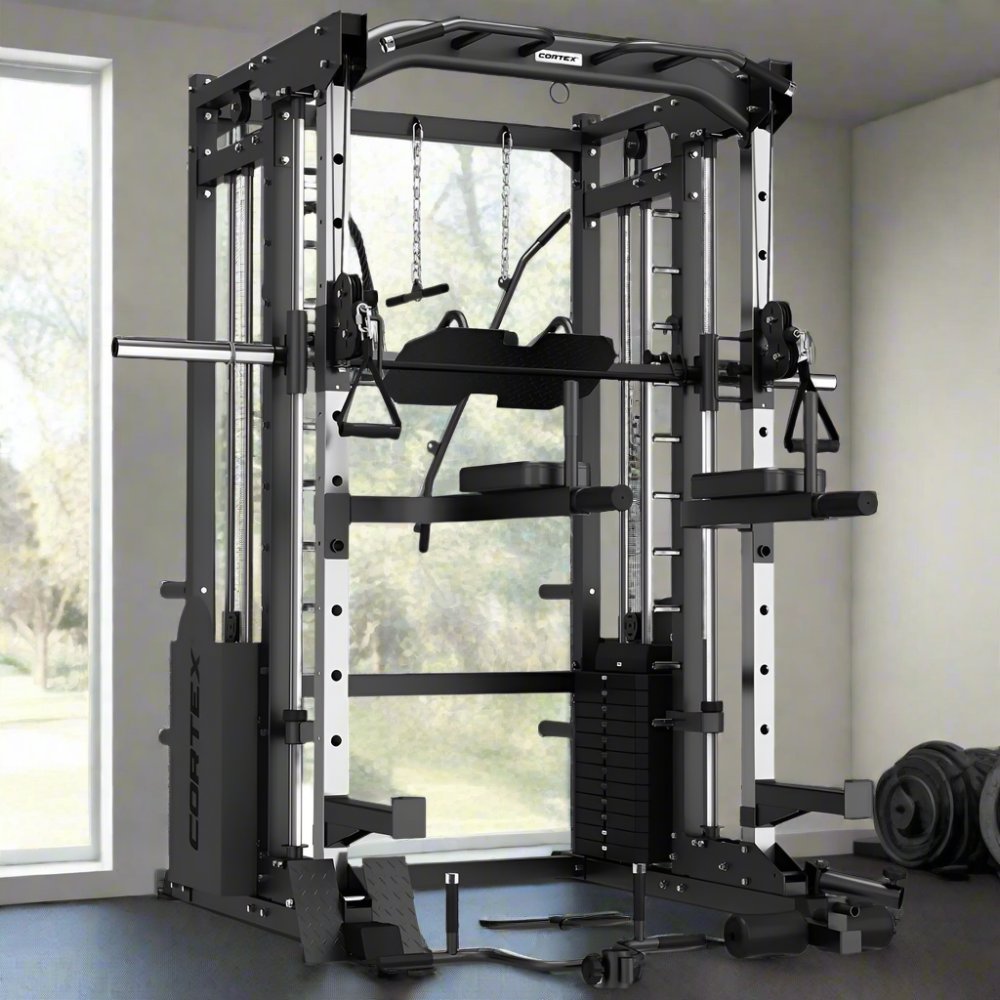
CORTEX SM-25 6-In-1 Power Rack With Smith & Cable Machine
Complete home gym under one frame
The Cortex SM-25 Multi-Gym is a comprehensive, space-saving strength station that combines a Smith machine, power rack, cable trainer, landmine, chin-up, and dip stations into one robust frame. Featuring dual 74 kg weight stacks for precise resistance adjustments and a reinforced steel build rated to 200 kg, it delivers gym-level versatility and durability.
Check PriceAt a glance
- Combines Smith machine, power rack, cable trainer, landmine, chin-up and dip stations in one compact frame
- Dual 74 kg weight stacks (per pulley unit) enable fine-grained resistance adjustments
- Constructed from powder-coated 16-gauge steel; rated up to 200 kg for heavy-duty use
- Includes versatile accessories: lat pulldown bar, curl bar, tricep rope, landmine handle, leg roller, extension chains, multi-grip pull-up bar, adjustable dip handles, and storage pegs
- Occupancy size: approx. 203.5 × 151.3 × 218.6 cm; net weight around 296 kg
- Warranty: 12-month parts replacement
Who it suits
- Home gym users wanting a commercial-grade, all-in-one strength station
- Trainers from beginner to advanced seeking scalable, comprehensive resistance training
- Those with space for a robust, multifunctional frame, wanting to replace multiple machines
Why it’s a customer favourite
- Delivers gym-quality versatility, consolidating multiple training stations into one solid build
- Dual-stack resistance allows smooth progression and precise load control
- High-tensile ergonomics and accessory breadth ensure long-term comfort, usability and progression

CORTEX PR-4 Foldable Squat Rack & Pulley Machine
Space-saving, versatile squat rack
The Cortex PR-4 Space-Saver Folding Squat Power Rack is a clever and compact solution for home gyms that need to maximise space without sacrificing functionality. It features a durable 2 mm steel-gauge frame that folds flat when not in use—reclaiming valuable floor area—while still supporting squats, bench presses, pull-ups, and more. This rack offers flexibility and performance in a high-quality package.
Check PriceAt a glance
- Foldable steel frame (2 mm gauge); folds from 190 × 157.6 × 226.6 cm to 167 × 70.5 × 226.6 cm
- Supports standard 6 ft and Olympic 7 ft barbells; weight storage included
- Unique attachments: lat bar, low-row bar, landmine, resistance band pegs, inside/outside J-hook configurations
- Robust capacity: J-hooks (220 kg), safety spotter (200 kg), pull-up bar (200 kg), plate storage (100 kg); accommodates users up to 200 cm tall
Who it suits
- Home gym users short on space seeking a full-featured strength rack
- Users wanting flexibility to perform a wide range of compound exercises
- Those needing durable and neat storage of gear within a minimal footprint
Why it’s a customer favourite
- Ingenious folding design that converts to open space in seconds
- Excellent build quality with high weight ratings for safety and stability
- Comprehensive attachment suite keeps workouts varied and scalable
Will it fit? Measure your room
Plan for the frame and movement space. Allow ~0.5–1 m clearance each side for adjusting weights, loading plates etc. Most frames sit ~210–220 cm tall; 2.4 m ceilings are ideal (check headroom if doing pull-ups).
- Mark the machine’s footprint with painter’s tape.
- Add 0.5–1 m around for bench moves, rows and cable travel.
- Check doorways, stairs and ceiling for moving the cartons and raising the frame upright.

Tape the footprint, then add clearance and confirm ceiling height for pull-ups.
Specs that matter
1) Weight stacks & resistance
Entry multi-gyms often ship with a 70–75 kg stack in ~5 kg steps—great for beginners and many intermediates. Some models are upgradable to ~98 kg, allowing you to future-proof your strength.
Dual-stack functional trainers effectively double total pinned load for heavy cable work. Some hybrids also let you plate-load pegs to increase resistance beyond the base stack.
Rule of thumb: Big cable moves (rows, pulldowns) often need ~40–60 kg effective load; legs may need more. Choose upgradable stacks or dual stacks if you love heavy pulls and leg work.
2) Pulley ratio & travel
A typical 2:1 ratio means you feel half the pinned weight while gaining longer handle travel and finer control. Many functional trainers use 2:1; some lat pulldowns run 1:1.
Pulley mini-calculator
- Pinned 50 kg @ 2:1 → ~25 kg at the handle
- Pinned 80 kg @ 2:1 → ~40 kg at the handle
- Pinned 60 kg @ 1:1 → ~60 kg at the handle

3) Cable positions & adjustability
Single-stack units work best with upper, mid and low pulleys. Dual-stack trainers should offer multiple height stops for perfect angles. Swivelling pulleys keep lines smooth at any angle.
4) Stations, attachments & storage
Multi-gyms: lat pulldown, low row, chest press/fly, preacher curl, leg extension/curl. Hybrids add rack J-hooks, safeties, pull-ups, dips and landmine.
Look for an attachment kit (lat bar, straight/curl bar, single handles, ankle strap, rope) and storage pegs/hooks to keep the space tidy.
5) Safety & build quality
Prioritise shrouded stacks, quality cables, reliable selector pins, stable frames, and rack safeties for solo lifts. Plate storage pegs can also increase stability.
6) Real exercise range
Most home gyms enable a decent variety of exercises; expect 30–60+ movements. Most households rotate 10–20 core exercises weekly and add accessories as needed.
Sample weekly programs (machine-only)
Beginner (3 days)
Full-body A:
- lat pulldown
- chest press
- leg extension
- seated row
- cable curl
- tricep press-down (extension)
Full-body B:
- low row
- chest fly
- goblet squat (if rack: Smith squat)
- face pulls
- calf raises
- planks
Full-body C:
- assisted pull-ups (or pulldown)
- incline press
- Romanian deadlift (Smith)
- cable lateral raise
- triceps dips (assisted)
- anti-rotation press
Intermediate (4 days)
Upper 1:
- pulldown
- bench press/Smith
- row
- incline fly
- curl
- tricep press-down (extension)
Lower 1:
- Smith squat
- leg curl
- split squat
- calf raise
- core
Upper 2:
- pull-ups
- overhead press
- single-arm row
- cable chest press
- rear delts
- rope crunch
Lower 2:
landmine RDL (if included), leg extension, step-ups, cable hip abduct/adduct, core.
Time-poor (2 days)
Day 1:
- pulldown
- press
- row
- squat/leg press
- curl
- tricep press-down (extension)
Day 2:
- pull-ups or pulldown
- incline press
- hip hinge (Smith/RDL)
- lunge
- lateral raise
- core
Top picks by use-case
Budget beginner, tight space
Pick: single-stack multi-gym with ~70–75 kg stack and 30+ exercises.
Shop this style → All-In-One Home Gyms
Intermediate lifter: barbells + cables
Pick: Functional Trainer with Smith, J-hooks, safeties, dips, pull-ups and landmine. Often allows plate-loading to boost cable resistance.
Shop this style → Functional Trainers
Classic movements, freedom & heavier loads
Pick: traditional squat rack with J-hooks and Spotter Arms; ideal for serious compound lifts.
Apartment-friendly vs Garage gym
Apartments: favour all-in-one home gyms for the compactness. Some people keep them on their balconies (beware weather damage/rust), while others allocate a spare bedroom as their gym room.
Single-car garage: you can go either way here, all-in-ones are great for their compactness while functional trainers can also be used (check space); add 8–12 mm rubber tiles, store plates on pegs for stability.
Double Garage or shed: dedicated squat racks and larger functional trainers shine; plan for wider footprints, dedicated plate trees and potentially additional equipment (leg press, cardio machines).
Buyer checklist
- Space: floor area taped out; ceiling ≥2.3–2.4 m for pull-ups; doorway/stair access measured.
- Training style: barbell vs cables; users (1–3 people); weekly frequency.
- Progression: upgradable stack vs dual stacks; plate-load options.
- Safety: stack shrouds, J-hooks, spotter arms, cable quality.
- Comfort: bench with seat adjustments, pulley height stops, handle variety.
- Extras: storage pegs, attachments included, after-sales support.
Delivery & assembly: what to expect
Even entry units can total ~150 kg across 10-12 cartons; advanced hybrids can approach ~300 kg. Build in the room of use with two people.
Functional trainers are complex to assemble - grab a mate, a couple of beers in the esky and plan for a half a day (if you're savvy on the tools) or a full day to be safe
Route cables carefully, align the weight stacks and rods correctly and keep all your bolts half-tight, then final-tighten when everything aligns. If DIY isn’t your thing, budget for pro assembly when available (expect costs starting from $400-800 depending on your location and the equipment - chat to our team to learn more).
Double-check ceiling height before raising tall frames upright, especially under 2.4 m ceilings.
Safety & maintenance schedule
- Every session: use rack safeties; keep hands clear of stacks and guide rods.
- 30 days post-build: re-torque all bolts; check cable routing.
- Monthly: inspect cables, pins and carabiners; check shroud fixings.
- Quarterly: clean/lube guide rods and pivots; wipe bars and handles to prevent rust.
Most units are designed freestanding—only anchor if the brand provides dedicated points. Plate storage pegs can add stability.
Warranty
All our products come with a minimum 12 month parts replacement warranty. Look for clear coverage on frame, moving parts, cables, and labour. Keep receipts, note serial numbers, and retain assembly photos for support.
Cost of ownership vs gym membership
Here's some rough break-even maths to help with budgeting (or persuading the wife that this is a great idea):
| Scenario | Upfront Investment | Time to break-even (Gym fees @ $22/week) | Lifetime savings (avg product lifespan ~10 years) |
|---|---|---|---|
| Entry-Level Single-stack Home Gym | $900-1,500 | ~10-17 months | ~$9,900 to $10,500 |
| Functional Trainer | $2,200-4,000 | ~22-45 months | ~$7,400 to $9,400 |
| Traditional Squat Rack | $1,500-3,000 | ~17-34 months | ~$8,400 to $9,900 |
Decision helper flow
- Do you barbell squat/bench? Yes → Squat Rack. No → next.
- Need compact and versatile? Yes → Functional Trainer. No → next.
- Prefer guided movements on a budget? Yes → Multi-station Home Gym. No → mix barbell + cables (All-in-One).
Home Gym FAQs
1) Which type of home gym should I buy: multi-station, functional trainer, or rack hybrid?
If you want guided movements and simplicity, a multi-station single-stack gym is compact and covers 30+ exercises—great for beginners and budget-conscious buyers. If you want maximum versatility, a functional trainer gives dual stacks, many pulley heights, and a smooth 2:1 ratio for precise loading. If you love barbells and cables, a rack hybrid (rack + Smith + cables) adds J-hooks, safeties, pull-ups, dips and landmine in one footprint.Tip: Compare options here → Home Gyms • Functional Trainers • All-in-One.
2) How much weight stack do I really need?
Entry single-stacks around 70–75 kg cover most beginners and many intermediates for upper-body work. If you expect to progress quickly or want heavier rows/leg work, choose a model with an upgrade path to ~98 kg or go dual-stack.
3) What’s the difference between 1:1 and 2:1 pulley ratios?
1:1: the handle feels the full pinned weight (shorter cable travel). 2:1: the handle feels ~half the pinned weight (longer, smoother travel and finer load increments)—common on functional trainers.
4) Will a home gym fit under a 2.4 m ceiling?
Many frames are in the ~210–220 cm height range, which suits a 2.4 m ceiling. Check the exact height on the product page and allow extra headroom if you plan to do pull-ups.
5) Do I need to bolt my home gym to the floor?
Most modern units are designed to be freestanding. Using storage pegs with weight plates can increase stability. Only anchor if the manufacturer provides dedicated points/instructions.
6) Can I build muscle effectively with a home gym?
Yes. Multi-stations list 30+ movements, and functional trainers/rack hybrids add near-unlimited angles and progressions. Dual stacks with 2:1 pulleys make fine load jumps easy to recover from while still challenging.
7) What attachments are “must-have” to start?
A solid starter kit usually includes a lat bar, straight/curl bar, single handles, triceps rope, and an ankle strap. Many multi-gyms include these out of the box; check inclusions before you buy.
8) Do all-in-one systems include a barbell and plates?
Usually not. Functional trainers and rack hybrids often require you to add an Olympic bar and weight plates for free-weight lifts; the cable stacks handle the cable exercises. Review the “What’s included” list on each model.
9) Are Smith machines good (and safe) for beginners?
Smith bars provide a fixed path with built-in catches, which is great for solo training on squats/presses. Many all-in-ones pair the Smith with a rack, so you can progress to free-bar work using safeties.
10) How hard is assembly—and can one person do it?
Expect multiple heavy cartons and lots of parts; plan a two-person build. Cable routing and plate-stack setup take time; follow the manual and only final-tighten when everything aligns.
11) Can I train legs properly on a home gym?
Yes. Look for leg extension/curl on multi-stations, and for rack hybrids/functional trainers, use Smith squats, split squats, RDLs, cable hip work, and landmine movements (if included).
12) What should I check before I buy?
Space and ceiling height; stack size/upgrade path; pulley ratio; attachment inclusions; stability features; and whether you’ll add a barbell/plates. Compare by style here → Home Gyms • Functional Trainers • All-in-One.


